
In the global industrial landscape of 2025, where infrastructure projects are scaling to unprecedented heights, the ‘price-per-unit’ procurement model is rapidly becoming obsolete. In massive shipyard operations, cross-country oil pipelines, and automotive assembly lines, a single consumable represents far more than its direct cost. A 115mm abrasive wheel is a precision instrument that dictates the speed of a weld-prep line and the safety profile of a thousand-man workforce.
The technical complexity of resin-bonded abrasives often remains a mystery to first-time buyers and even seasoned procurement officers. An error in specification selection (e.g., using standard carbon steel discs on Inox piping) doesn’t just result in lower efficiency; it triggers chemical cross-contamination, surface degradation, and high-risk safety failures.
At Robtec (J Long Tianjin Abrasives), we don’t just manufacture tools; we engineer industrial confidence. Since our 1984 origin as a research incubator of the Chinese Academy of Sciences, we have pioneered the standards for Northern China’s abrasive export industry. This briefing unveils the 7 technical secrets that global industrial leaders use to optimize their ‘cost-per-cut’ and ensure uncompromised operator safety.
1. Decoding the Alphanumeric DNA: A vs. WA vs. ZA
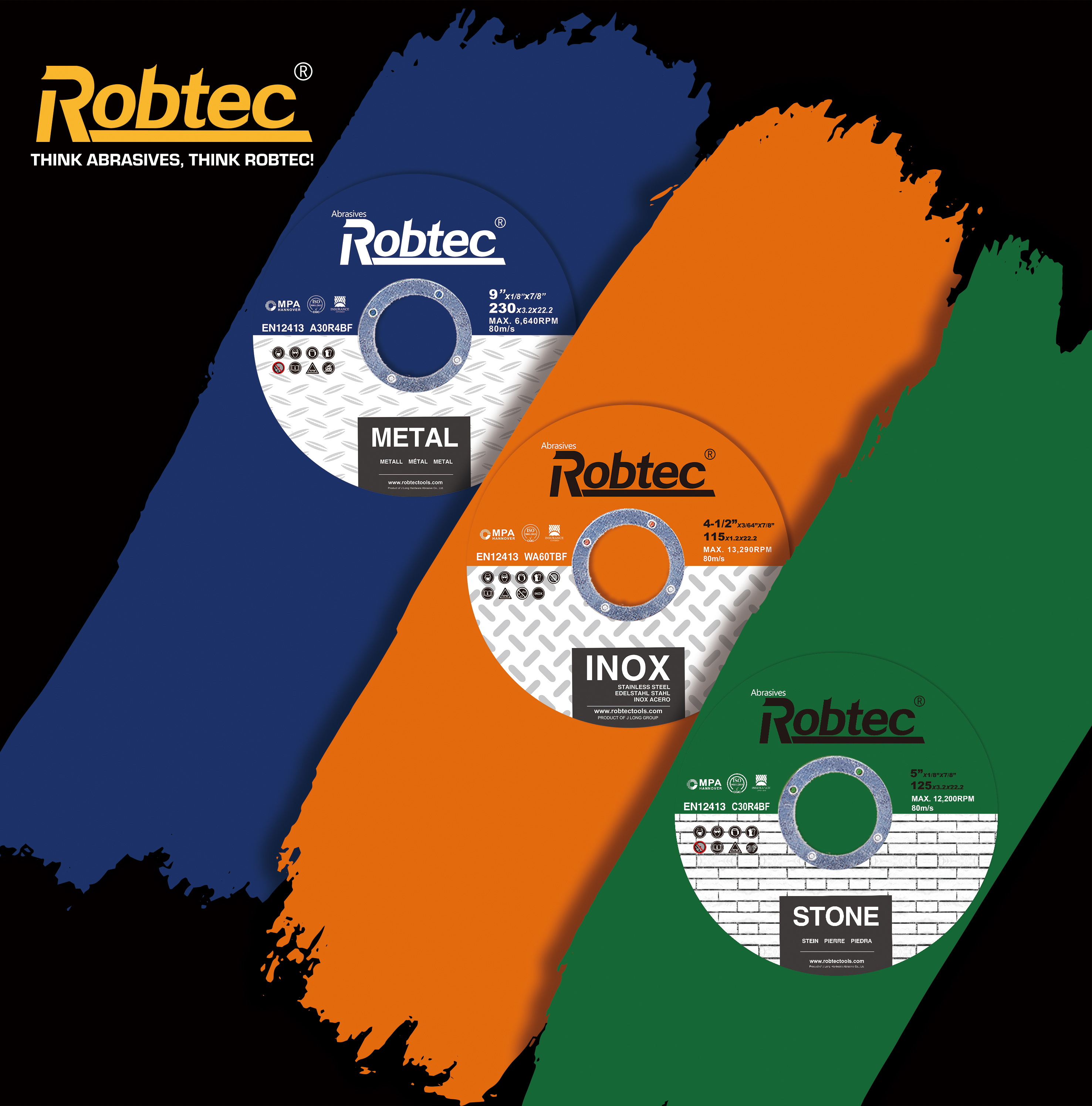
The specification printed on every Robtec disc (e.g., WA60TBF) is a performance blueprint. For an engineer, understanding this alphanumeric code is the difference between a clean cut and a scorched workpiece:
- • A (Brown Aluminum Oxide): Valued for its toughness and durability. It is the industrial workhorse for high-tensile carbon steel, structural iron, and general-purpose metal fabrication where tool longevity is the priority.
- • WA (White Aluminum Oxide): Characterized by high purity and superior friability (self-sharpening). This is non-negotiable for Stainless Steel (Inox) because it maintains a cool cutting temperature, preventing the ‘blueing’ effect and ensuring the corrosion-resistant properties of the alloy remain intact.
- • ZA (Zirconia Alumina): An aggressive, premium grain reserved for heavy-duty cast iron, foundries, and extremely hard alloys. ZA wheels are designed for high-pressure grinding where massive material removal is required in record time.
2. The 80m/s Safety Paradigm
In professional industrial zones, an abrasive wheel’s linear speed is standardly rated at 80m/s. However, the label is merely a claim; the German MPA Safety Certification is the proof. Every Robtec professional series wheel is subjected to rotational burst tests and impact trials. Safety-first procurement isn’t an expense—it’s a risk-mitigation strategy that prevents million-dollar liability claims and protects your most valuable asset: your people.
3. The RPM & Kinetic Energy Balance
High-performance abrasive wheels rely on kinetic energy to ‘self-sharpen.’ For small diameter discs(4″-5″), if the angle grinder’s RPM falls below 10,000, the abrasive grains will simply ‘glaze over.’ This creates excessive friction and heat instead of cutting. We ensure our technical specifications align with modern industrial power tools to maintain peak cutting energy across the entire tool life.
4. Double-Net (Fiberglass Net) Reinforcement
Safety is forged from the inside out. Robtec was the first Chinese manufacturer to successfully mass-produce ultra-thin wheels (≤2.0mm) using an integrated ‘Double-Net’ (fiberglass net) structure. This internal security mesh acts as a skeleton, enabling the disc to withstand extreme lateral forces. In a heavy-duty industrial shop, using a single-net disc is a critical safety compromise; dual-net is the professional baseline for high-speed cutting.
5. Manufacturing Consistency: The ±0.5g Rule
Abrasive quality is defined by its consistency across a million pieces. Manual mixing in generic factories leads to ‘soft spots’—invisible areas of lower density that cause vibration. At Robtec’s 20,000 sqm smart facility, our automated batching achieves a precision of ±0.5 grams. This ensures every wheel provides a uniform G-Ratio (material removal vs. tool wear), protecting your grinder’s bearings and reducing operator fatigue.
6. Thermal Logic: The ±1°C Intelligent Tunnel Kiln
The ‘heart’ of an abrasive wheel is the resin bond, which is cured through a dynamic, multi-stage temperature curve. If the actual temperature deviates significantly during the 24-hour curing cycle, the resin matrix becomes brittle. Robtec utilizes 60-meter intelligent tunnel kilns with computerized controls that maintain the actual firing temperature within a strict ±1°C of the pre-set temperature curve. This level of thermal logic guarantees that every wheel has identical hardness and tensile strength, preventing the inconsistent wear patterns that plague lower-tier brands.
7. Storage & Traceability: Protecting the Investment
Resin-bonded abrasive wheels are sensitive to environmental moisture. For industrial facilities, storing discs directly on concrete floors is a performance killer. At Robtec, our ERP-tracked, climate-controlled warehousing ensures total traceability. From the raw material batch to the end-user’s workbench, every disc is digitally logged, ensuring that project specifications are met with 100% data integrity.
The ROI of Premium Abrasives: Why Shipyards Choose Robtec?
Our 2025 sales analytics confirm a 15% increase in adoption within the heavy energy and marine sectors. The reason is simple: Total Cost of Ownership (TCO). By utilizing Robtec’s high G-Ratio wheels, large-scale facilities typically report a 20% reduction in downtime for tool changes. Furthermore, the cleaner, cooler cuts produced by our WA series significantly reduce rework on high-cost stainless steel pipes and plates. In heavy industry, consistency isn’t just a quality metric—it’s a financial lever.
Technical FAQ for Professional Buyers
Q1: How does ±0.5g precision directly lower my facility’s operational costs?
A: Precision batching ensures a uniform G-Ratio across your entire tool inventory. This allows your fabrication teams to schedule maintenance and tool replacements with mathematical accuracy, eliminating ‘surprise’ failures that stall high-volume production lines.
Q2: What is the benefit of the Flat (Type 41) profile for 230mm abrasive wheels?
A: For heavy-duty piping and thick structural steel, a perfectly flat (Type 41) profile is required to maintain a straight, vertical cut depth. Our 230mm flat discs provide the maximum usable abrasive surface and eliminate the clearance issues often associated with depressed-center wheels in deep industrial grooves.
Q3: Why is German MPA certification considered the ‘Safety Passport’ for abrasives?
A: MPA (Materialprüfungsamt) is the world’s most rigorous testing authority. Achieving this certification means Robtec’s wheels have been independently tested for burst speeds exceeding 120m/s and impact resistance under extreme stress. It provides the highest level of liability protection for industrial operators.
Are you ready to optimize your industrial cost-per-cut strategy?
Download our latest E-Catalog or contact our technical sales team for a customized volume quotation.
Post time: 03-08-2026