
In the world of metal fabrication, “one size fits all” is a costly mistake. If you have ever seen a freshly cut stainless steel joint begin to tea-rust, or experienced premature disc wear, you are likely using the wrong abrasive specification.
Choosing between a Carbon Steel cutting disc and a Stainless Steel (Inox) cutting disc is a matter of chemical purity and thermal physics. At J Long (Tianjin) Abrasives Co., Ltd., we’ve engineered our professional series to solve these industrial challenges through 40 years of manufacturing expertise.
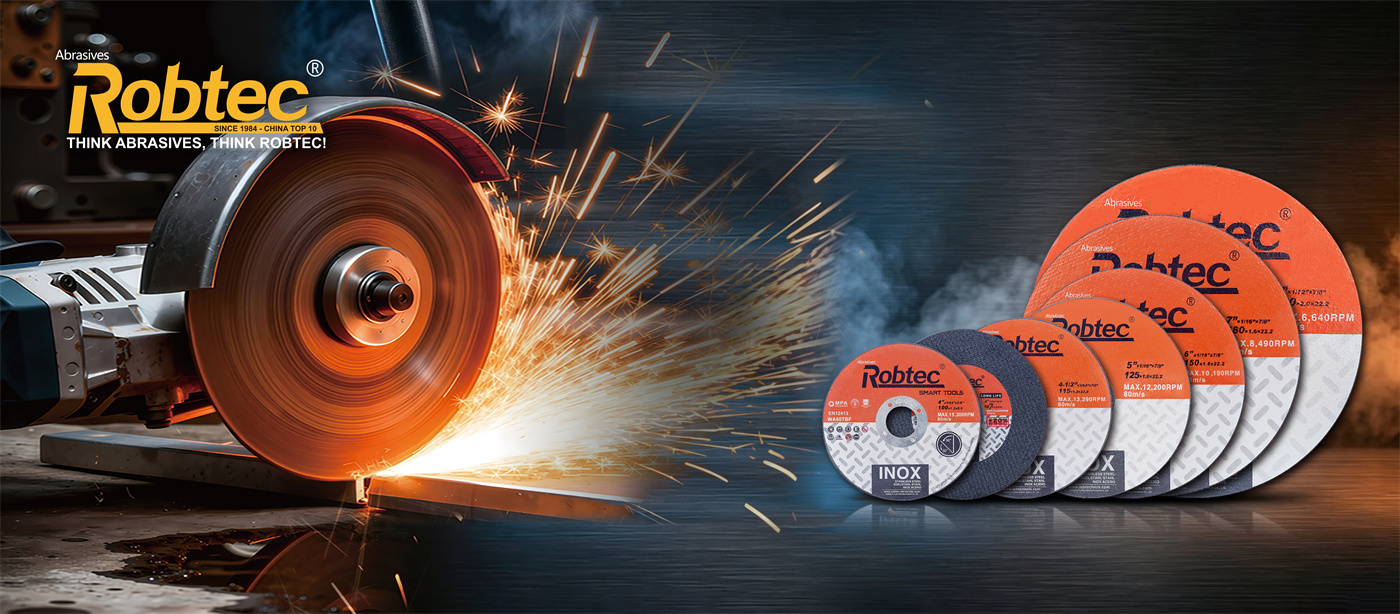
1. The “Iron-Free” Standard: Protecting Your Inox Workpiece
The most critical technical requirement for cutting stainless steel is an iron-free (Fe < 0.1%) abrasive matrix.
• The Risk: Standard steel discs contain iron, sulfur, and chlorine. During cutting, micro-particles from the disc embed into the stainless steel surface, creating “seeds” for oxidation that lead to corrosion.
• The Robtec Solution: Our premium INOX series is certified iron-free, sulfur-free, and chlorine-free, ensuring your high-end fabrications remain pristine and corrosion-resistant.
2. Abrasive Grain Selection: WA vs. A Grains
The grain type determines how effectively the disc removes material without overheating:
• A (Brown Alumina): Durable and tough, ideal for standard carbon steel, structural iron, and general-purpose metalwork.
• WA (White Alumina): High-purity and more friable (self-sharpening). We use premium WA grains for our stainless steel cutting discs because they constantly fracture to reveal new sharp edges, maintaining a cool cut on tough alloys.
3. Strength in Thinness: Ultra-Thin Fiberglass Net Technology
Our full range of ultra-thin discs (from 100mm to 230mm) represents the pinnacle of high-efficiency cutting:
• Thermal Management: Ultra-thin profiles (≤2.0mm) reduce the contact area, minimizing friction and preventing the “blueing” effect on stainless steel.
• Safety Engineering: Utilizing our patented fiberglass net reinforcement, even our largest 230mm x 1.6mm flat (Type 41) discs maintain extreme structural integrity at linear speeds of 80m/s. These discs are strictly flat, with no raised center, ensuring precise tracking.
• RPM Precision: For maximum efficiency, our 4″ and 5″ discs operate at over 10,000 RPM, while our large-diameter wheels provide optimized torque for heavy-duty industrial fabrication.
4. The Robtec Advantage: ±0.5g Precision & Traceability
Every Robtec disc is a product of our 20,000 sqm smart factory in Tianjin:
• Consistency: Our automated batching system ensures a ±0.5g precision in raw material mixing, ensuring a consistent G-Ratio across millions of pieces.
• Quality Standards: Through ERP and MES software, we guarantee that every batch meets the rigorous German MPA Safety Certification and EN 12413 standards.
FAQ: Optimizing Your Industrial Sourcing
Q: Can I use an Inox disc to cut standard carbon steel?
A: Yes. While an Inox disc (WA grain) is highly efficient on carbon steel, it is a trade-off. Because WA grains are more friable, the disc will wear down faster than a dedicated Carbon Steel (A grain) disc.
Q: What is the benefit of the Flat (Type 41) profile for 230mm discs?
A: The Type 41 flat profile provides the maximum usable depth of cut and allows for straight, precise tracking in deep industrial cuts. It is designed for maximum efficiency without the clearance issues sometimes found in depressed center wheels.
Ready to elevate your industrial output?
Visit www.irobtec.com to download the full E-Catalog or contact our technical sales team for a customized quote.
Post time: 23-06-2026